

By Melinda Pattan, BSN, RN, IBCLC
Introduction
One of the most common questions I hear from new mothers is, “How do I know if my baby has a good latch?”
It’s an excellent question—and an important one.
A deep, effective latch is one of the foundations of successful breastfeeding. When your baby latches well, they can transfer milk more efficiently, stimulate a healthy milk supply, and nurse comfortably. An effective latch also helps protect your nipples from unnecessary pain and damage, making breastfeeding a more positive experience for both of you.
Unfortunately, many mothers leave the hospital still feeling unsure whether breastfeeding is actually going well. They may wonder if their baby is getting enough milk, question whether discomfort is normal, or worry that every feeding should look exactly like the illustrations in a breastfeeding handbook.
The truth is that breastfeeding is a learned skill.
Although babies are born with natural feeding reflexes, breastfeeding still requires coordination, practice, and patience. Mothers are learning, too. During those first days and weeks after birth, both you and your baby are discovering what works best together. It’s completely normal to make small adjustments in positioning, experiment with different holds, and occasionally relatch your baby several times before finding a comfortable rhythm.
As both an International Board Certified Lactation Consultant (IBCLC) and a NICU nurse, I’ve cared for thousands of breastfeeding families over the years. I’ve also breastfed five of my own children. One thing I’ve learned is that parents often focus on finding one “perfect” sign that tells them everything is going well.
In reality, that’s not how breastfeeding works.
A good latch isn’t determined by a single feature. Instead, it’s a combination of how breastfeeding looks, feels, and functions over the course of an entire feeding. Your baby’s mouth position, sucking pattern, swallowing, diaper output, weight gain, and your own comfort all work together to paint the full picture.
Rather than searching for perfection, I encourage families to look for reassuring patterns. One shallow latch doesn’t mean breastfeeding is failing. One sleepy feeding doesn’t automatically mean your baby isn’t getting enough milk. Looking at the whole breastfeeding relationship over time provides much more meaningful information than focusing on one isolated moment.
This article will walk you through exactly what to watch for during a feeding, what a good latch should feel like, signs your baby is transferring milk effectively, common reasons breastfeeding can become uncomfortable, and when it’s time to seek additional support. My hope is that by the end, you’ll feel more confident recognizing the signs of an effective latch and better prepared to know when something deserves a closer look.
Table of Contents
🌿 Quick Take
Signs of a good latch include a wide-open mouth, lips flanged outward, a deep latch with plenty of breast tissue in your baby’s mouth, rhythmic sucking with audible or visible swallowing, and comfortable breastfeeding without ongoing nipple pain or nipple damage. Your baby should appear satisfied after most feedings, produce an age-appropriate number of wet and dirty diapers, and gain weight appropriately over time.
If breastfeeding remains painful, your baby struggles to stay latched, swallowing seems infrequent after your milk comes in, or weight gain becomes a concern, seek support from your baby’s pediatrician and an International Board Certified Lactation Consultant (IBCLC). Early evaluation often prevents small breastfeeding challenges from becoming larger ones.
What Is a Good Latch?
A good latch is much more than simply getting your baby onto the breast.
When your baby latches deeply, they take a generous mouthful of breast tissue—not just the nipple. This allows the nipple to rest comfortably toward the back of the mouth, where it is protected during sucking. Your baby’s tongue, jaw, and palate work together to create gentle suction and rhythmic compression that removes milk efficiently while minimizing friction on the nipple.
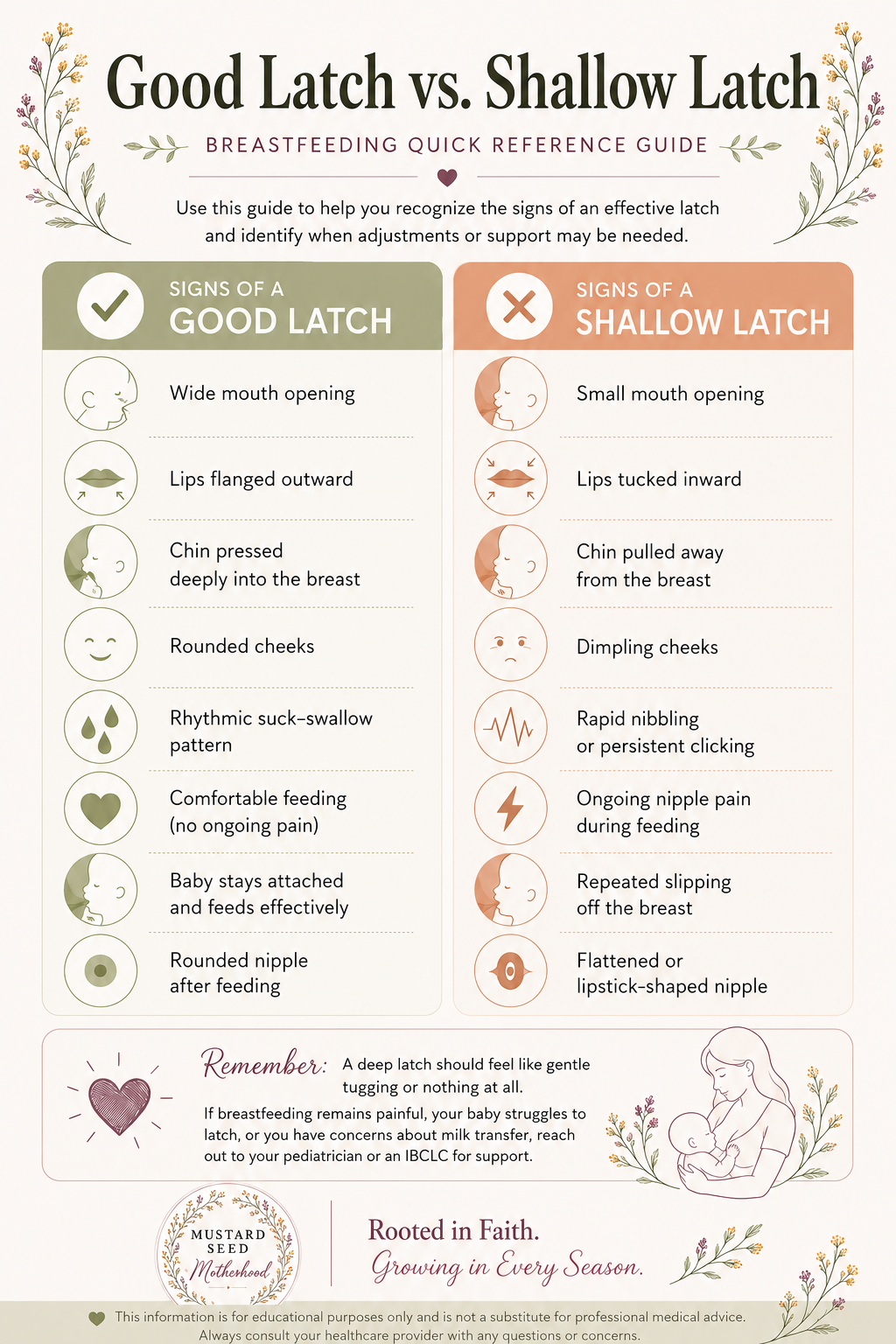
A shallow latch, on the other hand, often places excessive pressure directly on the nipple. Instead of compressing the milk ducts effectively, your baby may repeatedly pinch or rub the nipple between the tongue and palate. This can lead to persistent pain, nipple trauma, inefficient milk transfer, longer feedings, and frustration for both mother and baby.
It’s also important to understand that every mother’s breast anatomy is different. Breast size, nipple shape, and areola size vary tremendously. Because of these normal differences, there is no single picture that defines a “perfect” latch. Some mothers naturally see more areola above the baby’s upper lip, while others do not. Rather than focusing on how much areola is visible, it’s more helpful to evaluate the entire feeding and whether milk is being transferred effectively.
One of the biggest misconceptions I hear is that if breastfeeding hurts, mothers simply need to “tough it out.”
I whole heartedly disagree with that advice.
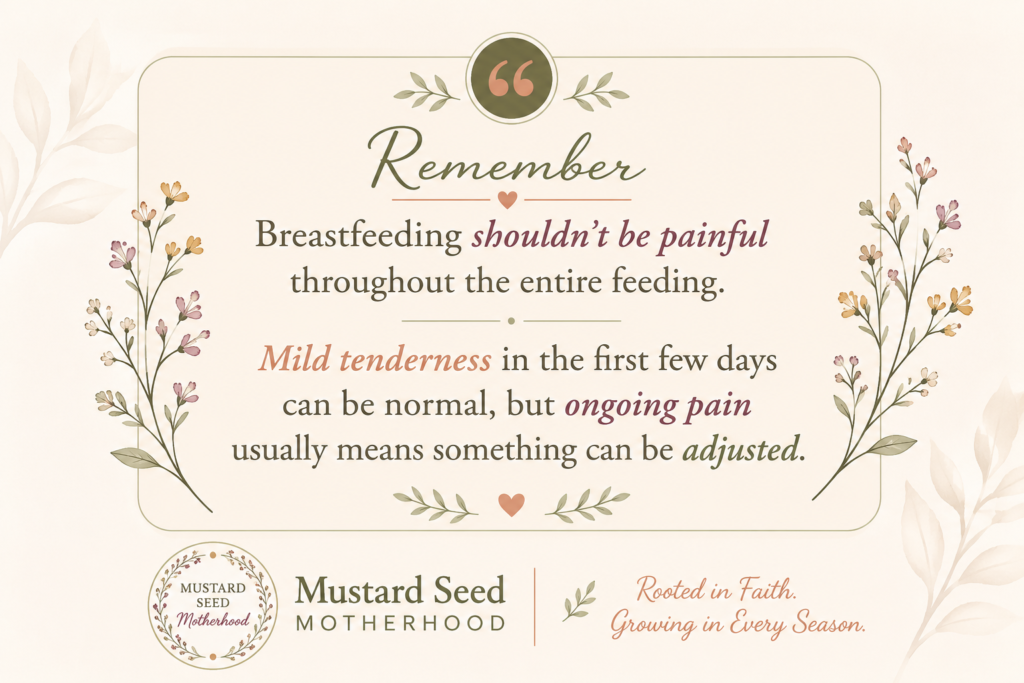
While some mothers notice temporary tenderness during the first few days postpartum, persistent pain, nipple damage, or pain that continues throughout a feeding should never be dismissed as something you simply have to endure. Those symptoms deserve an evaluation because they often indicate that something can be improved.
Why a Good Latch Matters
A deep latch benefits both you and your baby in ways that extend far beyond comfort.
For your baby, an effective latch supports efficient milk transfer, adequate nutrition, healthy weight gain, and fewer feeding frustrations. Babies who remove milk well generally spend less energy working to obtain milk and often finish feedings more satisfied.
For mothers, a deep latch helps stimulate and maintain milk production while reducing the likelihood of nipple trauma, blocked ducts, engorgement, and other common breastfeeding concerns. Comfortable breastfeeding also makes it much easier to continue nursing for as long as you and your baby desire.
Perhaps most importantly, recognizing the signs of a good latch builds confidence. Instead of second-guessing every feeding, you’ll begin trusting what you see, what you feel, and how your baby is growing.
And that confidence is one of the greatest gifts breastfeeding can offer.
What a Good Latch Looks Like
Once your baby is attached to the breast, it’s natural to wonder whether they’re actually latched deeply enough. Many parents spend the first several days leaning over their baby, trying to compare what they see to diagrams on the internet or pictures in breastfeeding books. While those illustrations can be helpful, real-life breastfeeding doesn’t always look exactly like the textbook examples.
Rather than looking for one perfect sign, observe the entire feeding.
Most babies who are latched deeply share several reassuring characteristics.
Your baby’s mouth should be opened very wide before coming onto the breast—almost like a yawn. As they latch, their chin should make contact with the breast first, allowing the lower jaw to scoop up a generous amount of breast tissue before the upper lip closes around the breast.
Once attached, their lips should be gently flanged outward rather than curled inward. Think of “fish lips” rather than pursed lips. While it’s possible for one lip to tuck in slightly without causing significant problems, flanged lips generally indicate a deeper, more comfortable latch.
Their cheeks should remain soft and rounded throughout the feeding. If you notice their cheeks pulling inward with every suck, this may suggest that your baby is struggling to maintain suction.
One reassuring sign many parents overlook is how relaxed their baby becomes during a feeding. As babies settle into an effective nursing rhythm, their shoulders relax, their hands often open, and their entire body appears calmer. Instead of constantly repositioning or pulling away from the breast, they remain comfortably attached while nursing.
What You Might Actually See During a Feeding
Every baby nurses a little differently, but these observations are commonly seen during an effective feeding:
• A wide, relaxed mouth that stays open throughout most of the feeding.
• The chin buried deeply into the breast.
• The nose either lightly touching the breast or remaining just clear enough for comfortable breathing.
• Lips gently flanged outward.
• Rounded cheeks without dimpling.
• Slow, rhythmic jaw movements after your milk lets down.
• A baby who remains attached without repeatedly slipping off.
• Relaxed hands and body posture as the feeding progresses.
• A baby who naturally releases the breast when satisfied.
If one of these signs is missing occasionally, don’t panic. Instead, step back and evaluate the overall feeding rather than focusing on one isolated observation.

What a Good Latch Feels Like
Perhaps the biggest misconception surrounding breastfeeding is the belief that pain is simply something mothers must endure.
I hear this often in my practice.
Many mothers have been told:
“Just give it two weeks.”
“Your nipples have to toughen up.”
“Breastfeeding always hurts at first.”
While it’s true that breastfeeding can feel unfamiliar during the first several days postpartum, ongoing pain is not considered normal.
A good latch should feel like firm, rhythmic tugging rather than pinching, biting, burning, or sharp pain.
Once your baby begins actively nursing, most mothers describe the sensation as pressure rather than pain.
Some mothers notice a brief moment of sensitivity as the baby first latches, particularly during the first few days after birth. However, that discomfort should improve quickly as your baby settles into a deeper latch.
If you find yourself curling your toes, holding your breath, counting the seconds until the feeding ends, or dreading the next nursing session, your body is telling you that something deserves further evaluation.
Persistent pain can occur for many reasons, including:
• A shallow latch
• Breast engorgement
• Vasospasm
• Nipple trauma
• Oral restrictions
• Improper positioning
• Infection
• Other breastfeeding challenges
The good news is that many of these problems improve significantly once the underlying cause is identified.
What Your Nipples Should Look Like After Feeding
One of the easiest ways to evaluate a latch is to look at your nipple immediately after the feeding.
Ideally, your nipple should look very similar to how it appeared before nursing.
A round nipple usually suggests that pressure was distributed appropriately during the feeding.
However, if your nipple appears:
• flattened
• creased
• lipstick-shaped
• blistered
• cracked
• bleeding
your baby may not have achieved a deep latch, or another breastfeeding issue may need attention.
Pain and nipple damage should never simply be accepted as part of breastfeeding.
Signs Your Baby Is Swallowing Milk
Many parents worry that because they can’t see milk entering their baby’s mouth, they have no way of knowing whether breastfeeding is actually working.
Fortunately, babies give us many clues.
During the first minute or two of a feeding, you’ll often notice quick, flutter-like sucking. These rapid sucks stimulate your let-down reflex.
Once milk begins flowing, your baby’s sucking pattern changes.
Instead of quick, shallow sucks, you’ll begin seeing slower, deeper jaw movements followed by brief pauses.
Those pauses are swallowing.
Some babies make a soft “kah,” “cuh,” or quiet gulping sound.
Others swallow almost silently.
Watching your baby’s jaw is often more reliable than trying to hear every swallow.
You may notice:
• the chin dropping slightly farther with each swallow,
• a brief pause before the next suck,
• subtle movement near the ears or temples,
• increasingly relaxed body language.
As your milk supply becomes established, swallowing usually becomes much easier to recognize.
Signs Your Baby Is Getting Enough Milk
While latch is extremely important, it is only one piece of the breastfeeding puzzle.
The best way to know whether breastfeeding is going well is to evaluate your baby’s overall progress.
Reassuring signs include:
• Nursing at least 8–12 times every 24 hours during the newborn period.
• Audible or visible swallowing during many feedings after your milk comes in.
• Producing an age-appropriate number of wet and dirty diapers.
• Steady weight gain following the normal newborn weight loss.
• Appearing satisfied after most feedings.
• Breasts feeling softer after nursing.
Remember that no single feeding tells the whole story.
Some feedings will naturally be longer than others.
Some babies nurse quickly.
Others take their time.
Rather than watching the clock, focus on your baby’s hunger cues, milk transfer, diaper output, and growth over time.
Good Latch vs. Shallow Latch
How to Help Your Baby Achieve a Deeper Latch
The encouraging news is that many latch concerns improve with just a few small adjustments. You don’t need to completely relearn breastfeeding—in many cases, changing your baby’s positioning by only a few inches can make a remarkable difference.
Before attempting another latch, take a deep breath and make yourself comfortable. A relaxed mother often helps create a more relaxed feeding.
Start by holding your baby tummy-to-tummy with you. Their ears, shoulders, and hips should stay aligned in a straight line so they don’t have to twist their neck to reach the breast.
Support your breast with your hand well behind the areola so your fingers don’t interfere with your baby’s latch. Gently tickle your baby’s upper lip with your nipple and wait patiently for a very wide, yawn-like mouth.
This step is one of the most commonly rushed parts of breastfeeding.
Many babies will bob their head, lick the nipple, or open only halfway several times before finally opening wide enough for a deep latch. Waiting those few extra seconds often makes all the difference.
When your baby’s mouth opens wide, quickly bring your baby to your breast—not your breast to your baby.
Aim your nipple toward the roof of your baby’s mouth so their chin and lower jaw make contact with the breast first. This helps them take a generous mouthful of breast tissue rather than grasping only the nipple.
If the latch feels painful after several sucks, don’t hesitate to gently break the suction by inserting a clean finger into the corner of your baby’s mouth and try again.
Relatching is not failure.
It’s often exactly what leads to a better feeding.
Common Reasons for a Shallow Latch
Even when parents are doing everything “right,” babies sometimes struggle to latch deeply.
Common reasons include:
Positioning
Even small changes in body alignment can affect how deeply your baby latches.
Breast Engorgement
Very full breasts can become firm, making it difficult for babies to grasp enough breast tissue. Hand expressing a small amount of milk before feeding may soften the areola enough to improve the latch.
Prematurity
Late preterm babies and babies born early often tire more quickly and may need additional support while developing feeding endurance.
Sleepiness
Babies recovering from birth, jaundice, or certain medications may have difficulty staying actively engaged during feedings.
Oral Anatomy
Tongue-tie, lip-tie, high palates, muscle tension, or other oral differences can sometimes affect latch. Because many factors influence breastfeeding, it’s important to have a complete feeding assessment rather than assuming one diagnosis.
Fast or Slow Milk Flow
Some babies struggle when milk flows very quickly, while others become frustrated if milk seems slower than expected.
Most of these challenges improve with individualized support once the underlying cause is identified.
Troubleshooting Common Latch Concerns
My baby keeps slipping off the breast.
Wait for a wider mouth before latching and bring your baby closer so the chin reaches the breast first. Frequent slipping often indicates that your baby needs a deeper latch or additional support.
My baby makes clicking sounds.
Occasional clicking can happen, but persistent clicking throughout the feeding may suggest your baby is losing suction or struggling to maintain the latch.
My baby falls asleep almost immediately.
Try skin-to-skin contact, gentle stimulation, breast compressions, or rubbing your baby’s feet to encourage active feeding.
My nipples still hurt.
Persistent pain deserves evaluation. Breastfeeding should become comfortable once your baby is actively nursing.
When to Seek Help
One of the greatest misconceptions about breastfeeding is that mothers should simply “keep trying” for weeks despite severe pain.
Please don’t.
Early support often prevents small problems from becoming much larger challenges.
Contact your baby’s pediatrician or an International Board Certified Lactation Consultant (IBCLC) if:
• Breastfeeding remains painful despite repositioning.
• Your baby produces fewer wet or dirty diapers than expected.
• You rarely notice swallowing after your milk has come in.
• Your baby is not gaining weight appropriately.
• Your nipples become cracked, bleeding, blistered, or repeatedly damaged.
• Your baby cannot maintain a latch.
• Feedings consistently feel frustrating or exhausting.
Sometimes the solution is surprisingly simple.
Other times, your IBCLC may identify concerns such as oral anatomy differences, positioning adjustments, milk supply concerns, or other factors affecting feeding.
Seeking help is never a sign that you’ve failed.
It’s simply another way of caring for both yourself and your baby.
Frequently Asked Questions
Can breastfeeding hurt at first?
Some mothers notice temporary sensitivity during the first few seconds of latching in the early postpartum period. However, breastfeeding should quickly become comfortable. Persistent pain, pinching, burning, or nipple damage is not considered normal and deserves evaluation.
How do I know my baby is swallowing?
Watch for slower jaw movements with brief pauses after your milk lets down. Some babies make a quiet swallowing sound, while others swallow almost silently. Looking for rhythmic jaw movement is often more reliable than listening for one specific sound.
What if my baby keeps slipping off the breast?
Repeated slipping often suggests a shallow latch or another feeding challenge. Reposition your baby, wait for a very wide mouth before latching, and seek support if the problem continues.
Does every feeding look the same?
No.
Babies nurse differently depending on their age, alertness, milk flow, and stage of development. Focus on your baby’s overall feeding pattern rather than expecting every feeding to be identical.
Should I wake my sleepy newborn to feed?
Most newborns should breastfeed at least 8–12 times every 24 hours. Your pediatrician will guide you on when it’s appropriate to allow longer stretches between feedings.
Can my baby have a good latch and still not get enough milk?
Yes.
Although a deep latch is essential, milk transfer can also be affected by prematurity, jaundice, oral anatomy, maternal milk supply, and other medical conditions. That’s why diaper counts, weight gain, and a complete feeding assessment are so important.
How long does it take to improve a shallow latch?
Some babies improve immediately after small positioning adjustments, while others need several days—or longer—of practice and individualized support. Every breastfeeding journey is different.
Affiliate Disclosure
Some links on The Mustard Seed Motherhood are affiliate links. This means I may earn a small commission at no additional cost to you if you choose to make a purchase through those links. I only recommend products I personally use, trust, or believe will genuinely benefit the families I serve.
Products That May Help
The following products may support a more comfortable breastfeeding experience. While no product replaces skilled breastfeeding support, these are items I frequently recommend to families.

- 100% Polyester, 100% Polyurethane Foam
- Imported
- ERGONOMIC DESIGN: Elevate your nursing journey with our unique nursing pillow. The wrap-around feature ensures ideal pos…

- Organic & Lanolin-Free: Motherlove’s organic Nipple Cream for breastfeeding soothes nursing nipples. Nipple Cream is uns…
- Multi-Use Formula: Use as a pump lubricant; apply a thin layer of this nipple butter to the inside of the pump flange. A…
- Award-Winning: Nipple Cream has been recognized and awarded by parenting organizations such as The Bump, BabyCenter, and…

- Our slip proof silicone cups keep Elvie Catch secure, and helps prevents leaks
- Collecting up to 1 ounce, 30 milliliters, of milk on each side; No more wasted milk in your breast pads
- Elvie Catch lays flat against a woman’s breast and can be worn comfortably for up to three hours; The uniquely shaped si…

- Fill: 100% Polyester
- Ergonomic Design – Trusted baby essentials built for the most comfortable feeding positions. The U-shaped Boppy nursing …
- Softer Pillow – We heard parents’ feedback and adjusted the cushion to be less firm, while maintaining the thick, long-l…
Looking for More Motherhood Favorites?
Every family is different, and every season of motherhood brings new needs. I’ve curated my favorite breastfeeding, newborn, postpartum, and baby essentials in one place to help you find trusted products with confidence.
🌿 Browse Mel’s Amazon Storefront
Conclusion
If there’s one thing I hope you take away from this article, it’s this: breastfeeding is a learned skill, not a test you have to pass.
Both you and your baby are learning together.
Some feedings will feel effortless, while others may require a little more patience and a few positioning adjustments. That doesn’t mean you’re doing anything wrong—it simply means you’re gaining experience together.
A good latch isn’t about achieving perfection every time. It’s about creating a comfortable, effective feeding relationship that allows your baby to transfer milk well while protecting your comfort and supporting your breastfeeding goals.
If something doesn’t feel right, trust your instincts.
Pain, poor weight gain, persistent frustration, or concerns about milk transfer are all valid reasons to seek help. Early support from your pediatrician or an International Board Certified Lactation Consultant (IBCLC) can often identify small adjustments that make a tremendous difference.
Most importantly, remember this:
You are not expected to know everything on day one.
Breastfeeding is a journey of learning, and asking for help is one of the strongest things you can do for yourself and your baby.
Related Articles
• Why Won’t My Baby Latch? 10 Common Causes and What to Do
• How to Know if Your Baby Is Getting Enough Breast Milk
• Best Breastfeeding Positions for a Deep, Comfortable Latch (coming soon)
About the Author
Melinda Pattan is a Registered Nurse, International Board Certified Lactation Consultant (IBCLC), Christian, and mother of five. Through The Mustard Seed Motherhood, she combines professional expertise with personal experience to provide evidence-based breastfeeding education, postpartum support, newborn care guidance, and faith-filled encouragement. Her mission is to help mothers feel informed, supported, and confident as they care for their babies.
Medical Disclaimer
The information provided on The Mustard Seed Motherhood is intended for educational and informational purposes only and should not be considered medical advice, diagnosis, or treatment. Every mother and baby are unique, and breastfeeding challenges can have many different causes. Always consult your Pediatrician, Obstetric provider, International Board Certified Lactation Consultant (IBCLC), or another qualified healthcare professional regarding concerns about breastfeeding, infant feeding, your health, or your baby’s health. When in doubt, reach out.
References
Academy of Breastfeeding Medicine. (2021). ABM Clinical Protocols.
https://www.bfmed.org/protocols
American Academy of Pediatrics. (2022). Policy Statement: Breastfeeding and the Use of Human Milk. Pediatrics, 150(6), e2022057988.
https://publications.aap.org/pediatrics/article/150/6/e2022057988/190409/Breastfeeding-and-the-Use-of-Human-Milk
American Academy of Pediatrics. (n.d.). Breastfeeding Frequently Asked Questions. HealthyChildren.org.
https://www.healthychildren.org
Centers for Disease Control and Prevention. (2025). Breastfeeding.
https://www.cdc.gov/breastfeeding/
La Leche League International. (n.d.). Positioning and Latching.
https://llli.org/breastfeeding-info/positioning/
National Library of Medicine. (n.d.). Breastfeeding. MedlinePlus.
https://medlineplus.gov/breastfeeding.html
World Health Organization. (2023). Infant and Young Child Feeding.
https://www.who.int/news-room/fact-sheets/detail/infant-and-young-child-feeding