

By Melinda Pattan, BSN, RN, IBCLC | Mom of five
Quick Answer
One of the most common questions new breastfeeding mothers ask is, “How do I know if my baby is getting enough milk?”
Learning how to know if your baby is getting enough milk can help you feel more confident during the early weeks of breastfeeding.
There can be signs that reassure you or point you in the direction of consulting your babies pediatrician for further evaluation. This article aims to take the guess work out and help you build the confidence needed without having to worry if your baby is getting enough.
If your baby is feeding effectively, producing plenty of wet and dirty diapers, gaining weight appropriately, and your healthcare provider is pleased with their growth, those are all excellent signs that breastfeeding is going well.
Although breastfeeding doesn’t come with ounce markings like a bottle, you don’t have to guess whether your baby is getting enough milk. There are evidence-based signs that help us confidently evaluate how breastfeeding is going.
In This Article
How to Know if Your Baby Is Getting Enough Milk
If you’ve found yourself staring at your sleeping newborn wondering…
“Did they actually eat enough?”
…I want you to know something.
You’re not alone.
In fact, this is one of the most common concerns I hear as an International Board Certified Lactation Consultant (IBCLC). It’s also a question I remember asking myself as a first-time mom.
Breastfeeding is beautiful, but it can also feel incredibly uncertain.
When you bottle-feed, you can easily see exactly how many ounces your baby drank.
When you breastfeed, you can’t.
Instead, you may find yourself wondering:
• Are they eating enough?
• Why do they want to nurse again already?
• Is my milk supply too low?
• Should they be sleeping this much?
• Do I need to supplement?
Those questions are completely normal.
The good news is that your body and your baby were designed to work together, and your baby gives us several reliable signs that breastfeeding is going well.
Rather than focusing on one feeding, one pumping session, or one difficult day, I encourage parents to step back and look at the whole picture.
That’s exactly how we evaluate breastfeeding in the hospital and in outpatient lactation practice.
Let’s walk through those signs together.
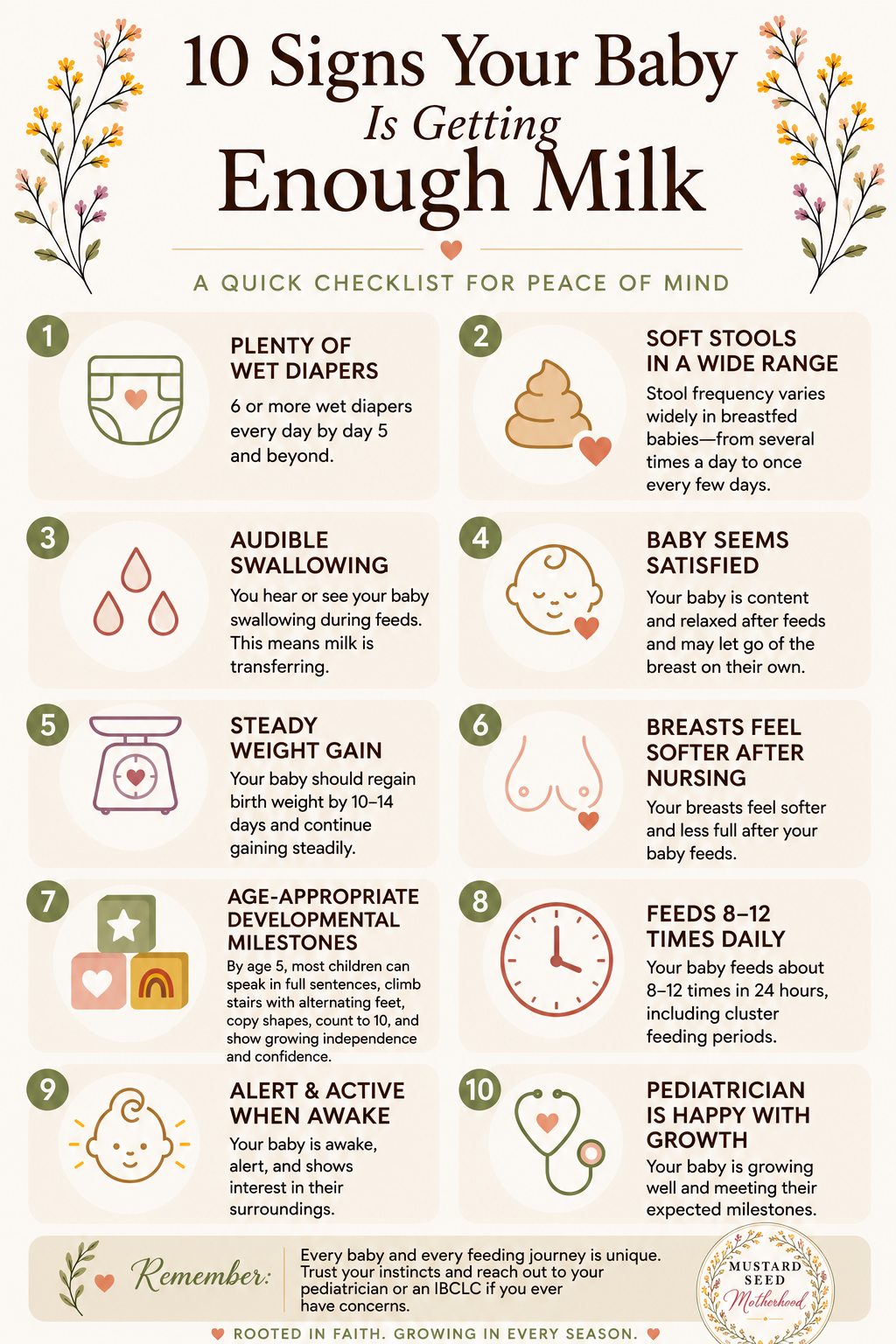
1. Your Baby Has Plenty of Wet Diapers
One of the easiest and most reassuring ways to know your baby is getting enough milk is by paying attention to diaper output.
Once your milk has transitioned from colostrum to mature milk—usually around days 3–5 after birth—most healthy, full-term newborns should have:
• At least six wet diapers every 24 hours
• Pale yellow or nearly clear urine
• Diapers that feel noticeably heavy
Wet diapers tell us your baby is taking in enough milk to stay hydrated.
If your baby’s diaper output suddenly decreases, or the diapers remain dark and concentrated after your milk has come in, it’s worth reaching out to your pediatrician or IBCLC for guidance.
IBCLC Insight 🌿
One diaper by itself doesn’t tell us much.
But six or more wet diapers every day? That tells us that there is enough going in to produce what is coming out.
2. Your Baby Is Having Regular Stools
Dirty diapers are another important clue.
In the first several days after birth, babies pass a thick, sticky stool called meconium.
As breastfeeding becomes established, those stools gradually change.
They become:
• mustard yellow
• loose
• seedy
• frequent
Many newborns stool after almost every feeding during the first several weeks.
As babies grow, however, stooling patterns often change.
Some exclusively breastfed babies may go several days between bowel movements after the first month while still receiving plenty of milk.
This is one reason I encourage parents not to compare their baby with another baby online.
Every baby has their own normal pattern.
On the flip side of this, if a baby is consistently having decreased stool, it is worth mentioning to your pediatrician. While it can be a very normal thing, it can sometimes be associated with lower volume intakes.
3. Your Baby Is Effectively Transferring Milk
Many parents assume breastfeeding is simply sucking.
In reality, effective feeding follows a coordinated pattern of suck, swallow, and breathe. Watching how your baby feeds can often tell you much more than watching the clock.
Early in a feeding, babies often suck quickly to stimulate your milk ejection reflex (your “let-down”). Once your milk begins flowing, you’ll usually notice the rhythm change. The sucking becomes slower, deeper, and more purposeful. Some babies make quiet swallowing sounds, while others swallow so subtly that it’s easier to notice the gentle pause in their jaw movement.
During an effective feeding, you may notice:
- Rhythmic jaw movement
- Brief pauses between sucks
- Soft swallowing sounds
- Slower, deeper sucks after your milk lets down
These are reassuring signs that your baby is actively transferring milk.
If your baby seems to suck continuously without swallowing, repeatedly slips off the breast, becomes frustrated at the breast, or falls asleep after only a minute or two of every feeding, it may be helpful to have a feeding assessment. Sometimes a small adjustment in positioning or latch can make a tremendous difference.
🌿 IBCLC Insight
After breastfeeding five babies myself and helping countless families as an IBCLC, I can confidently say that every breastfeeding journey is different. Some babies are loud, enthusiastic swallowers. Others are incredibly quiet and subtle. Rather than focusing on one moment, I encourage parents to watch the feeding as a whole. With a little patience, good support, and plenty of practice, most mothers and babies learn to work together beautifully.
If you’re ever unsure what effective milk transfer looks like, an IBCLC can observe a feeding and help you recognize these reassuring signs with confidence.
4. Your Breasts Feel Softer After Nursing
Although this isn’t true for every mother, many women notice that their breasts feel:
• lighter
• softer
• less full
after a good feeding.
This often indicates that milk has been removed effectively.
As your milk supply becomes more established over the coming weeks, your breasts may naturally feel softer all the time.
That doesn’t mean you’ve lost your milk supply.
In fact, it’s usually a sign that your body has become more efficient at making exactly what your baby needs.
One of the biggest myths I hear is:
“My breasts don’t feel full anymore, so I think my milk dried up.”
For most mothers, that’s simply not true.
Your body is incredibly smart.
As breastfeeding becomes established, milk production shifts from being driven primarily by postpartum hormones to being regulated by how often milk is removed from the breast.
That means your body gradually learns your baby’s unique feeding needs.
Instead of storing large amounts of milk between feedings, many mothers begin producing milk more efficiently throughout the day.
Feeling softer doesn’t usually mean you’re making less milk—it often means your supply has regulated.
5. Your Baby Is Gaining Weight Appropriately
If I had to choose the single most reassuring sign that breastfeeding is going well, it would be steady weight gain over time.
It’s normal for babies to lose some weight after birth. In fact, many healthy newborns lose a small percentage of their birth weight during the first few days of life. As your milk supply increases and breastfeeding becomes established, your baby should begin gaining weight again.
Most healthy, full-term babies return to their birth weight by about two weeks of age, although every baby is different. Your pediatrician will follow your baby’s growth over time rather than focusing on a single weight check.
This is one reason I encourage parents not to weigh their baby at home multiple times a day. (Coming from a mama who weighed her fourth baby multiple times a day, I know how much anxiety and stress can come from watching the scale and not the baby). Weight naturally fluctuates throughout the day depending on feedings, diapers, and normal body processes. Frequent weighing often creates more anxiety than reassurance.(Trust me on this one. So much of the newborn joy was spend hovering the scale).
Instead, trust your baby’s signs and their healthcare provider to monitor growth trends over time.
Growth is a journey—not a single number.
6. Your Baby Appears Content After Many Feedings
Let’s clear up a very common misconception.
A content baby is not necessarily a baby who sleeps for four hours after every feeding.
Newborns are designed to eat frequently.
Some babies nurse for ten minutes.
Others nurse for thirty.
Some are naturally calm.
Others are alert and want to be held often.
Instead of asking, “Does my baby sleep for hours after eating?” ask yourself:
• Does my baby seem relaxed after many feedings?
• Do their hands open instead of staying tightly clenched?
• Do they release the breast on their own sometimes?
• Are they alert during awake periods?
• Are they continuing to have good diaper output?
Remember, babies don’t nurse only because they’re hungry.
They also nurse for comfort, warmth, connection, regulation, and security.
That doesn’t mean you don’t have enough milk.
It means your baby is doing exactly what babies were designed to do. Breastfeeding is one of the only communication methods babies have. They can send the signal that they need more milk, or they want comfort and security.

7. Your Baby Is Growing, Learning, and Meeting Milestones
Early in a feeding, babies often suck quickly to stimulate your milk ejection reflex (also known as your “let-down”).
Once milk begins flowing, you’ll usually notice the rhythm change.
The sucking becomes slower.
Deeper.
More purposeful.
You may even hear quiet swallowing.
Some babies are very obvious swallowers.
Others are much more subtle.
That’s why I encourage parents to watch the entire feeding instead of focusing on one moment.
If you’re unsure what effective milk transfer looks like, an IBCLC can observe a feeding and help you recognize these signs with confidence.
8. Pump Output Does Not Measure Your Milk Supply
This is probably one of the biggest myths in breastfeeding.
The amount you pump is not the amount of milk you make.
I wish every new breastfeeding mother knew this.
Breast pumps are incredible tools, but they are not perfect.
Your baby is almost always more effective at removing milk than a pump. (The reasons this would not be the case are coming soon on another blog post).
Several factors can affect pump output, including:
• Flange size
• Pump settings
• Time of day
• Stress levels
• Sleep deprivation
• Hydration
• How recently your baby nursed
• Whether you’re replacing a feeding or pumping after nursing
I’ve met mothers who pumped only one ounce but exclusively breastfed thriving babies.
I’ve also cared for mothers who pumped large amounts yet still needed feeding support for other reasons.
Please don’t let one pumping session convince you that your body isn’t making enough milk.
Look at the whole picture.
Always.
🌿 IBCLC Insight
One of the most common things I hear is:
“I only pumped two ounces. I must not have enough milk.”
Most of the time, that simply isn’t true.
Pump output tells us how much milk the pump removed during that session—not how much milk your body is capable of making over an entire day or how much milk your baby is removing in a single session. When I am supporting mothers, I often using their pumping output as a small piece of the much bigger puzzle.
9. Cluster Feeding Is Normal
If you’ve ever felt like your baby wanted to nurse every hour—or even every thirty minutes—you’ve probably experienced cluster feeding.
And yes…
It can be exhausting.
Cluster feeding often happens:
• During growth spurts
• In the evenings
• During developmental leaps
• When babies need extra comfort
Many mothers assume cluster feeding means their milk supply has disappeared.
In reality, it’s usually the opposite.
Frequent nursing sends your body an important message:
“My baby needs more milk.”
Your body responds by increasing production over the following days.
Think of cluster feeding as your baby’s way of placing tomorrow’s milk order today.
It’s hard.
It’s tiring.
But it’s also incredibly normal and one way that your baby can communicate their needs.
10. Trust the Whole Picture—Not One Moment
One difficult feeding doesn’t mean breastfeeding is failing.
One fussy evening doesn’t mean your milk supply disappeared.
One short pumping session doesn’t define your ability to nourish your baby.
Breastfeeding is never evaluated by a single moment.
Instead, we step back and ask:
• Is my baby growing?
• Are diapers appropriate?
• Is milk transferring?
• Does my baby appear healthy overall?
• Is my healthcare team pleased with growth?
When those answers are reassuring, you can take a deep breath.
Your baby is likely doing beautifully.
So what if those answers are not reassuring? In my humble opinion, your are an amazing mother and you are doing your best. You’re here, at whatever time it is in your part of the world, seeking and searching for answers to meet the needs of your little one. Your baby is so lucky to have you.
💚 Take a Deep Breath
If you’re reading this while holding your baby in the middle of the night, wondering if you’re enough…
I want you to hear this.
You are learning.
Your baby is learning.
Breastfeeding is a relationship—not a performance.
Some days will feel easy.
Other days will leave you questioning everything.
That is normal.
Please don’t let comparison steal the joy from your journey.
Every mother.
Every baby.
Every breastfeeding relationship is different.
Your story doesn’t have to look like someone else’s to be successful.
There are few seasons that require more quiet perseverance than caring for a newborn.
The world often celebrates the big milestones—the first words, the first steps, the first birthdays.
But God also sees the moments no one else notices.
He sees the 2 a.m. feedings.
The tears when breastfeeding feels harder than you expected.
The prayers whispered over your sleeping baby.
The moments you wonder if you’re doing enough.
None of those moments are wasted.
They are acts of love.
And love is never insignificant in the eyes of God.
So if today feels hard, remember this:
You don’t have to be a perfect mother.
You simply have to keep showing up with the love and strength God provides one day—and one feeding—at a time.

Frequently Asked Questions
How often should a newborn breastfeed?
Most newborns breastfeed 8–12 times every 24 hours, though many babies feed even more frequently during growth spurts or periods of cluster feeding. Rather than watching the clock, watch your baby. Feeding on demand helps ensure your baby gets enough milk while also supporting a healthy milk supply.
Is it normal for my baby to want to nurse every hour?
Yes, especially during the first several weeks.
Frequent nursing is often completely normal and is commonly seen during:
• Growth spurts
• Evening cluster feeding
• Developmental leaps
• Times when your baby needs extra comfort
Frequent feeding alone is not a sign that your milk supply is low. It can be used as a piece to the bigger puzzle.
My baby only nurses for five to ten minutes. Is that enough?
Sometimes.
Every baby is different.
Some babies are incredibly efficient feeders, while others prefer longer nursing sessions. Instead of focusing on the number of minutes, pay attention to whether your baby is swallowing well, having plenty of wet diapers, and gaining weight appropriately.
Can I tell how much milk my baby is getting by pumping?
No.
Breast pumps and babies remove milk differently. Many mothers who produce an abundant milk supply are surprised by how little they pump.
Pumping output is not an accurate way to measure your overall milk production.
When should I contact an IBCLC?
Don’t wait until breastfeeding feels impossible.
Reach out if you notice:
• Pain with feedings
• Difficulty latching
• Poor weight gain
• Fewer wet diapers than expected
• Concerns about milk supply
• Recurrent plugged ducts or mastitis
• A baby who seems frustrated at the breast
• Frequent “clicking” at the breast
Early support often prevents small challenges from becoming larger ones. You can often schedule a prenatal consult so that you feel prepared far beyond the first latch.
Products That May Help
Every family is different, but these are the breastfeeding products I most often recommend to make feeding, pumping, and postpartum recovery a little easier.
Some of the links below are Amazon affiliate links. This means that, at no additional cost to you, I may earn a small commission if you make a purchase through these links. I only recommend products I personally use, trust, or would confidently recommend to the families I care for.
👉 Browse My Breastfeeding Essentials
Related Articles
If you found this article helpful, you may also enjoy:
• Cluster Feeding Explained (Coming soon)
• How Often Should a Newborn Eat? (Coming soon)
• When Should You See an IBCLC? (Coming soon)
These articles build on one another to help you feel more confident throughout your breastfeeding journey.
Key Takeaways
If you only remember a few things from this article, let them be these:
• Your baby gives you reliable signs that breastfeeding is going well.
• Wet diapers, weight gain, and effective milk transfer are more meaningful than pump output.
• Cluster feeding is often normal and does not automatically mean your milk supply is low.
• Every breastfeeding journey looks different, and comparison can create unnecessary worry.
• If you’re concerned, seeking help early from your pediatrician or an IBCLC is one of the best things you can do for yourself and your baby. Asking for help should be encouraged. You should not have to navigate this all on your own. Sometimes having professional help can help you achieve your feeding goals beautifully, whatever they may be.
From My Heart
As both an IBCLC and a mother, I know how vulnerable the early days of breastfeeding can feel.
I’ve cared for countless families who wondered whether they were doing enough. I’ve also experienced those moments of uncertainty myself. When you’re exhausted, healing from birth, and learning to care for a brand-new baby, it’s easy to second-guess every feeding.
But here’s what I hope you take away from this article:
Your worth as a mother is not measured by ounces, pumping output, or whether breastfeeding looks exactly the way you imagined.
Motherhood isn’t about perfection.
It’s about showing up again and again with love.
Whether today felt easy or incredibly hard, every time you hold your baby close, respond to their cries, and meet their needs, you’re building something far more important than a feeding schedule.
You’re building trust.
You’re building security.
You’re building a relationship that will last long after the newborn stage is over.
That matters more than you know.
Final Encouragement
Mama, if no one has told you this today:
You’re doing a wonderful job.
The fact that you’re searching for answers tells me how deeply you care about your baby.
That love is one of your greatest strengths.
There will be days when breastfeeding feels effortless and days when it feels incredibly challenging.
On both kinds of days, remember this:
You don’t have to do motherhood perfectly.
You simply have to keep loving your baby the best you can.
One feeding.
One cuddle.
One prayer.
One day at a time.
Call to Action
I hope this guide helps you understand how to know if your baby is getting enough milk and gives you confidence during those first weeks.
If this article encouraged you, I’d love for you to stay connected with Mustard Seed Motherhood.
Continue Growing With Us
Motherhood was never meant to be walked alone.
If this article encouraged you, I’d love to stay connected.
- Browse more breastfeeding resources.
- Join our email community for practical encouragement and evidence-based education.
- Follow Mustard Seed Motherhood for support rooted in faith and grounded in truth.
We’re growing this community one mustard seed at a time, and I’m so grateful you’re here.
About the Author
Melinda Pattan, RN, BSN, IBCLC, is a registered nurse, International Board Certified Lactation Consultant, and mom of five. Through Mustard Seed Motherhood, she combines evidence-based education, professional experience, and a Christ-centered perspective to encourage mothers in every season.
References
American Academy of Pediatrics.How Often and How Much Should Your Baby Eat? HealthyChildren.org.
Academy of Breastfeeding Medicine.Clinical Protocol #2: Guidelines for Birth Hospitalization Discharge of Breastfeeding Dyads.
Academy of Breastfeeding Medicine.Clinical Protocol #3: Supplementary Feedings in the Healthy Term Breastfed Neonate (Revised 2017).
Centers for Disease Control and Prevention.Breastfeeding: Infant and Toddler Nutrition.
La Leche League International.Is My Baby Getting Enough Milk?
American Academy of Pediatrics.Milestones Matter: Your Child’s Growth & Development By Age 5. HealthyChildren.org.
Medical Disclaimer
The information provided on Mustard Seed Motherhood is intended for educational purposes only and should not replace personalized medical advice, diagnosis, or treatment from your physician, pediatrician, International Board Certified Lactation Consultant (IBCLC), or other qualified healthcare professional.
Every mother, every baby, and every breastfeeding journey is unique. What is normal for one family may not be normal for another. If you have concerns about your baby’s feeding, weight gain, diaper output, health, or your own well-being, seek guidance from a qualified healthcare provider who can evaluate your individual situation.
When in doubt, reach out. Asking questions early is one of the best ways to protect both you and your baby. You were never meant to navigate motherhood alone.
Last Reviewed
Last reviewed: July 2026
Written by: Melinda Pattan, RN, BSN, IBCLC
This article reflects current evidence and clinical recommendations available at the time of publication. Articles are periodically reviewed and updated to ensure information remains accurate and helpful for families.